We are in your area every month!

How Pure Water Window Cleaning Works

The science and kit behind a streak-free finish, for anyone who likes to know how things work
Just want a price? Get an instant quote on our homepage

Why tap water leaves spots

Tap water looks clear, but it carries dissolved minerals such as calcium and magnesium, picked up as it travels through the ground and pipes. Even the soft water we have in South Wales contains them.

When water evaporates, those minerals stay behind. That's what leaves spots and streaks on glass, and it's why traditional window cleaning needs soap and a squeegee to wipe the water away before it dries.

We take a different approach: remove everything from the water first, so there's nothing left to mark the glass.

How we make pure water

We make our own pure water at our base. Here's its journey from the tap to your windows.

1

Filters

Sediment and carbon filters catch grit, rust and chlorine, protecting the reverse osmosis membrane that follows.

2

Reverse osmosis

Our own in-house system pushes water through a membrane so fine that most dissolved minerals can't pass. Typically 95 to 99% are removed.

3

Storage tanks

The purified water is held in our storage tanks at base, so there's always a consistent supply ready to go.

4

Transfer to vans

A transfer system fills each van with water made to our own standard, ready for the day's cleaning.

5

Clean windows for you

Brushed and rinsed with pure water through our poles, leaving your glass, frames and sills streak-free.

Why we make our own. Many window cleaners rely on de-ionising resin alone, which gets less effective as it's used up, or buy water in from third-party suppliers. Investing in our own reverse osmosis system, storage tanks and transfer system means we control the quality ourselves, so every van leaves with the same consistent pure water.

Measuring purity: TDS

Water purity is measured in TDS, total dissolved solids, in parts per million (ppm). Zero means nothing at all is dissolved in the water. Tap water varies hugely by area: soft water areas like ours read far lower than hard water areas like London.

We clean with water at under 2 ppm. We check it with a TDS meter, and because we produce it ourselves, we keep it consistent rather than hoping a bought-in supply or a worn resin is up to standard.

2 ppmOur limitA 48 ppm safety margin before streaks50 ppmMax TDS before streaksAbove this, spots show60 ppmEdinburgh tap waterVery soft150 ppmCardiff tap waterSoft300 ppmDublin tap waterHard400 ppmLondon tap waterHard500+ ppm

Drawn to scale. TDS fluctuates, so tap water readings are approximate.

The water-fed pole

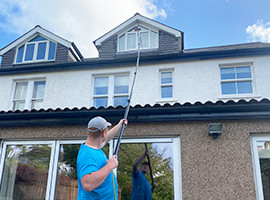
Instead of ladders, we use lightweight telescopic poles that carry the pure water up to a brush head with small jets. The pole reaches over 30ft from the ground.

The brush scrubs the glass, frames and sills to loosen dirt, then the jets rinse everything away with pure water. Because the water dries spot-free, there's no need to squeegee or wipe the glass afterwards.

Working from the ground is safer for our team, keeps ladders off your borders and paintwork, and lets us reach awkward windows above conservatories and extensions.

Cleaning dormer windows from the ground with a water-fed pole

Why it stays cleaner for longer

Pure water is sometimes called "hungry" water: with nothing dissolved in it, it readily takes up dirt and grime. Once rinsed, the glass is left with no soap film or mineral layer for new dirt to cling to.

That's why regular pure water cleaning tends to keep windows clearer between visits, and why frames gradually look better with each clean.

Questions for the curious

Is pure water safe for plants, pets and ponds?

Yes. It's simply water with the dissolved minerals taken out. There are no detergents or chemicals in it, so whatever runs off the glass is harmless to borders, lawns, pets and wildlife.

Why don't you use soap?

Soap leaves a thin film behind, and that film attracts dust and dirt, so glass cleaned with soap gets dirty again faster. Pure water loosens dirt on its own and dries with nothing left on the surface.

Why do windows look spotty after it rains?

Rain picks up dust, pollen and pollution on the way down, so when raindrops dry they leave those marks behind. Pure water has nothing in it to leave behind. If rain spoils a fresh clean, tell us within 48 hours and we'll come back for free.

How high can you reach?

Our water-fed poles reach over 30ft from the ground, which covers most three-storey homes, dormers and Velux windows without a ladder.

Do you clean the frames and sills too?

Yes, every visit. The brush scrubs the frames, sills and doors as well as the glass, and they're rinsed with the same pure water. Heavily weathered frames can take a couple of cleans to come up fully.

Is it really clean without drying the glass?

Yes. Drying with a squeegee or cloth is only needed when the water has minerals in it. With pure water, leaving it to dry naturally is what gives the spot-free finish.
Convinced?

Join our monthly round. Get your instant price on our homepage in under a minute.

Get my price